

Loyalty Structure & Incentive System
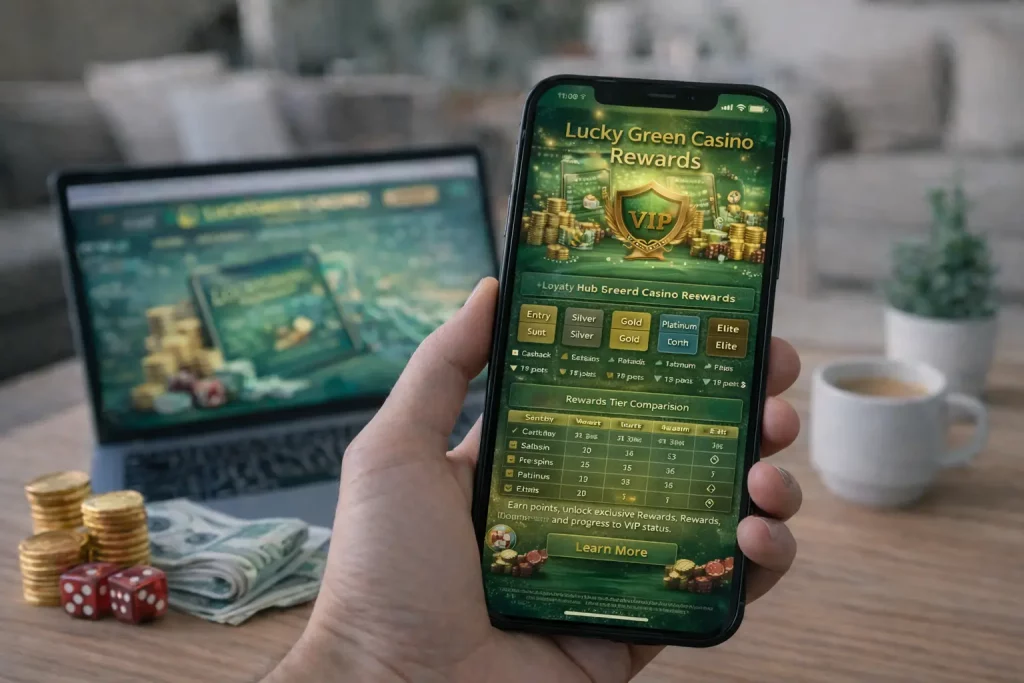
Reward systems form the structural backbone of long-term engagement in online casinos. While welcome promotions attract initial attention, sustainable player retention depends on ongoing loyalty mechanisms, tier progression incentives, cashback structures, and VIP privileges. Lucky Green Casino Rewards is designed as a multi-layered ecosystem that integrates wagering activity, deposit behavior, and gameplay consistency into a structured progression model.
Core Philosophy of the Rewards Program
A sustainable rewards framework balances two objectives:
• Incentivizing continued engagement
• Preserving financial sustainability
Lucky Green Casino Rewards appears structured around gradual progression rather than aggressive short-term promotional spikes. This suggests a long-term retention strategy rather than acquisition-only marketing.
Players who complete registration and initial Sign up processes gain automatic access to entry-level loyalty benefits, without requiring separate enrollment.
Points Accumulation Model
Most casino loyalty programs operate on a points-based mechanism. Players accumulate points through:
• Real-money wagers
• Participation in promotional campaigns
• Cashback eligibility
• Special tournament events
Points are typically awarded proportionally to wagering volume rather than net win/loss outcome.
Gameplay across digital Games categories and high-volatility Slots typically contributes to point accumulation at predefined ratios.
Tier Structure Overview
The rewards program is often divided into structured tiers such as:
• Entry
• Silver
• Gold
• Platinum
• VIP
Each tier unlocks progressively enhanced benefits.
Reward Tier Benefits
| Tier Level | Entry Requirement | Cashback Range | Weekly Perks | Withdrawal Priority |
|---|---|---|---|---|
| Entry | Automatic | 0–5% | Basic promotions | Standard |
| Silver | Moderate wagering | 5–8% | Reload bonuses | Standard |
| Gold | Higher wagering | 8–12% | Dedicated support | Medium |
| Platinum | Consistent activity | 12–15% | VIP promos | High |
| VIP | High monthly volume | 15%+ | Personal manager | Priority |
This structure illustrates a typical progressive rewards model rather than guaranteed program specifics.
Cashback Mechanics
Cashback is a central reward component. It typically functions as:
• Percentage-based return on net losses
• Weekly or monthly calculation period
• Manual or automatic claim process
• Wagering requirement application
Cashback programs smooth volatility and provide structured retention incentives.
Reward Points Allocation Distribution
Reload & Ongoing Incentives
Reload bonuses often complement tier benefits. These may include:
• Weekly deposit matches
• Free spin packages
• Boosted point multipliers
• Birthday promotions
Structured Bonus campaigns frequently integrate with loyalty tiers to create layered incentives.
Account Access & Reward Dashboard
Players track rewards through a centralized dashboard accessible after secure Login authentication. The dashboard typically displays:
• Current tier
• Accumulated points
• Cashback eligibility
• Pending promotions
• VIP qualification status
Transparency in reward tracking reduces ambiguity and increases trust.
Mobile Rewards Integration
Modern loyalty systems are optimized for mobile access. The Lucky Green Casino browser-based App interface typically allows players to:
• Track tier progress
• Claim cashback
• Activate promotions
• Monitor tournaments
Mobile visibility strengthens engagement continuity.
Strategic Role of Rewards
Rewards programs influence:
• Player retention duration
• Average monthly deposit volume
• Session frequency
• Cross-product engagement
A well-balanced loyalty structure encourages diversified gameplay rather than single-category concentration.
Lucky Green Casino Rewards – VIP Structure, Personalization & High-Tier Benefits
While entry-level rewards create baseline engagement, the true structural depth of a loyalty system becomes visible in its VIP architecture. Lucky Green Casino Rewards appears to operate with a layered VIP model that distinguishes between high-frequency players, high-volume depositors, and long-term consistent participants. VIP programs are not merely higher cashback percentages; they represent an ecosystem of personalized incentives, operational priority, and tailored support mechanisms.
VIP Qualification Logic
VIP eligibility is typically not automatic. Instead, it reflects cumulative activity across multiple dimensions:
• Monthly wagering volume
• Net contribution margin
• Deposit consistency
• Engagement duration
• Participation in promotional events
Qualification thresholds are rarely published in full detail to preserve operational flexibility. However, movement between tiers usually depends on rolling activity windows rather than lifetime wagering alone.
Players who actively explore diversified Games categories often accumulate points more consistently compared to single-session engagement patterns.
Personalization & Account Management
VIP structures introduce a higher degree of personalization. Common elements include:
• Dedicated VIP account manager
• Custom reload offers
• Flexible withdrawal limits
• Early access to tournaments
• Tailored free spin packages
Personalized management enhances communication clarity and reduces friction during reward redemption.
VIP players often access enhanced dashboard functionality within the secure account area after Login, where tier-specific privileges are displayed transparently.
Tournament & Competitive Incentives
Tournament overlays frequently integrate into loyalty frameworks. These include:
• Weekly slot leaderboards
• Time-limited wagering challenges
• Cashback races
• Prize pool competitions
• Random prize drops
Competitive overlays drive engagement intensity while remaining separate from core cashback structures.
High-tier Slots tournaments often provide multipliers or accelerated point conversion rates.
Risk Balancing Within VIP Programs
A sustainable VIP model must balance reward generosity with financial control. Operators typically implement:
• Tier reassessment windows
• Contribution weighting by game type
• Adjusted point multipliers
• Dynamic promotional budgeting
• Risk monitoring thresholds
Reward sustainability depends on structured financial governance rather than unlimited incentive expansion.
VIP Benefit Structure
| VIP Level | Estimated Monthly Activity | Cashback Range | Dedicated Manager | Priority Withdrawals |
|---|---|---|---|---|
| Silver | Moderate | 5–8% | No | Standard |
| Gold | High | 8–12% | Limited | Faster |
| Platinum | Very High | 12–15% | Yes | Priority |
| Elite | High & Consistent | 15%+ | Senior Manager | Accelerated |
Reward Acceleration Model
Cross-Product Engagement Incentives
Rewards programs often encourage cross-category play. For example:
• Enhanced points for live dealer participation
• Boosted earnings during weekend campaigns
• Cross-platform incentives linking desktop and mobile App usage
Encouraging varied gameplay reduces single-category exposure and strengthens engagement balance.
Reward Dashboard Transparency
Transparency remains central to trust. The rewards dashboard commonly displays:
• Tier qualification progress
• Cashback accrual
• Upcoming promotions
• Eligible reload campaigns
• Expiration timelines
Clear visibility reduces disputes and enhances satisfaction.
Responsible Engagement Safeguards
A responsible loyalty system integrates safeguards such as:
• Deposit limit integration
• Self-exclusion compatibility
• Activity reminders
• Spending visibility
Even when structured around Bonus campaigns, reward systems must remain aligned with responsible gaming standards.
Strategic Value of VIP Programs
VIP programs contribute to:
• Revenue stability
• Long-term engagement
• Brand loyalty
• Word-of-mouth referrals
• Competitive differentiation
When managed responsibly, VIP tiers create predictable engagement patterns rather than volatile churn cycles.
Cashback Mechanics, Free Spin Economics & Sustainability Model
A rewards system must operate within a controlled economic framework. While VIP tiers and promotional layers attract attention, the real stability of Lucky Green Casino Rewards depends on how cashback is calculated, how free spins are distributed, and how financial sustainability is preserved over time.
Cashback Calculation Framework
Cashback is generally calculated on net losses over a defined period, typically weekly or monthly. The core formula often resembles:
Net Loss = Total Wagers – Total Wins
Cashback = Net Loss × Tier Percentage
However, not all game types contribute equally. Contribution weighting may vary:
• High RTP live dealer games: lower contribution
• Standard video slots: full contribution
• Progressive jackpots: adjusted rate
• Table games: reduced contribution
This contribution differentiation prevents exploitation while preserving fairness.
Cashback Processing Workflow
A structured cashback workflow typically includes:
• Calculation period closure
• System-generated eligibility verification
• Manual or automatic credit issuance
• Wagering requirement confirmation
• Expiration timer activation
Players access their eligibility overview after secure Login authentication within the rewards dashboard.
Clear calculation visibility reduces confusion and strengthens trust.
Free Spin Distribution Logic
Free spins are commonly integrated into loyalty tiers. Distribution may be based on:
• Weekly activity thresholds
• Deposit-linked promotions
• Tournament participation
• Tier upgrades
• Seasonal campaigns
Free spins are often assigned to specific Slots titles to manage financial exposure.
Structured free spin allocation maintains balance between player engagement and risk control.
Reward Sustainability Economics
A loyalty system must preserve long-term sustainability. Casinos typically allocate a defined percentage of gross gaming revenue (GGR) toward rewards.
Illustrative allocation model:
• Cashback pool: 40% of rewards budget
• Free spins & reloads: 30%
• VIP perks & personalized offers: 20%
• Tournaments & competitions: 10%
Cashback & Incentive Allocation
| Reward Component | Basis of Calculation | Contribution Weighting | Financial Control Level |
|---|---|---|---|
| Cashback | Net loss percentage | Weighted by game type | High |
| Free Spins | Tier & campaign | Assigned titles | Medium–High |
| Reload Bonus | Deposit-linked | Fixed percentage | Medium |
| Tournament Prizes | Ranking-based | Prize pool capped | High |
| VIP Perks | Activity-based | Individual evaluation | Medium |
This table reflects a conceptual model rather than proprietary operator data.
Free Spin Value Conversion Model
Free spins convert to real balance only after wagering requirements are satisfied. Typical parameters include:
• Maximum cashout cap
• Wagering multiplier
• Game restriction
• Time limitation
Promotional Bonus funds tied to free spins often carry structured wagering conditions to ensure fairness and prevent arbitrage behavior.
Reward Budget Distribution
Behavioral Impact of Rewards
Rewards systems influence player behavior patterns:
• Increased session frequency
• Extended gameplay duration
• Cross-category participation in Games
• Higher retention among mid-tier players
• Reduced churn rates
A balanced structure avoids incentivizing unsustainable risk while encouraging responsible engagement.
Mobile Optimization of Rewards
Modern reward systems are fully accessible via browser-based App environments. Mobile optimization allows players to:
• Track cashback
• Monitor tier progression
• Activate promotions
• Claim free spins
Mobile access improves visibility and claim conversion rates.
Financial Risk Mitigation
Operators mitigate risk through:
• Contribution weighting adjustments
• Tier reevaluation cycles
• Expiration timelines
• Cashout caps
• Budgeted promotional allocation
This protects both operator solvency and long-term loyalty continuity.
Long-Term Retention Modeling
Sustainable reward programs are built around retention metrics such as:
• Monthly active users (MAU)
• Average revenue per user (ARPU)
• Churn rate
• Tier progression rate
• Cashback redemption rate
Rewards aim to stabilize engagement curves rather than create volatility spikes.
Competitive Positioning, Long-Term Value & Final Assessment
The final evaluation of Lucky Green Casino Rewards requires stepping back from individual components and assessing the system as a whole. Loyalty structures are most effective when they create sustained engagement without compromising operational stability. In this concluding section, we analyze competitive positioning, structural strengths, potential limitations, and long-term strategic value.
Competitive Positioning in the Market
Online casino loyalty programs generally fall into three structural categories:
• Minimal cashback-focused programs
• Aggressive high-percentage incentive systems
• Balanced tiered ecosystems
Lucky Green Casino Rewards appears positioned within the balanced tiered category. This structure integrates cashback, free spins, reload incentives, tournaments, and VIP personalization without relying exclusively on large upfront promotional spikes.
Compared to acquisition-heavy models, a structured loyalty framework supports predictable engagement cycles rather than short-lived traffic bursts.
Strengths of the Rewards Ecosystem
Several structural strengths are visible:
Clear Tier Progression
The tier system allows players to understand how activity translates into benefits.
Integrated Cashback
Cashback provides predictable recovery smoothing rather than volatile one-time promotions.
Cross-Product Engagement
Players are incentivized to explore diversified Games categories rather than remaining in a single vertical.
Mobile Compatibility
Reward tracking through the browser-based App interface ensures consistent access across devices.
Transparent Dashboard
Tier status, points accumulation, and cashback visibility reduce ambiguity.
Potential Limitations
Even well-structured systems present limitations:
Contribution Weighting
Not all game types contribute equally to rewards, which may reduce perceived transparency for some players.
Wagering Requirements
Promotional Bonus credits and free spins typically carry wagering conditions.
Tier Maintenance
High-tier benefits often require sustained monthly activity rather than lifetime qualification.
These structural constraints are standard within the industry and function as financial control mechanisms.
Comparative Loyalty Framework
| Feature | Minimal Model | Aggressive Model | Lucky Green Model |
|---|---|---|---|
| Cashback | Low | High but volatile | Balanced & tiered |
| Free Spins | Limited | High frequency | Structured & controlled |
| VIP Personalization | Rare | Selective | Progressive |
| Mobile Integration | Basic | Moderate | Fully integrated |
| Sustainability | High | Moderate | High |
This comparison highlights the stability-focused positioning of Lucky Green Casino Rewards.
Engagement Lifecycle Model
Rewards systems typically support three engagement phases:
Acquisition Phase
Players initially respond to welcome promotions.
Growth Phase
Reload bonuses, tournaments, and cashback increase activity.
Retention Phase
VIP tiers and personalized offers sustain long-term participation.
A well-balanced loyalty model stabilizes engagement through each phase rather than concentrating incentives exclusively at the beginning.
Retention Curve Model
Responsible Gaming Integration
Sustainable loyalty systems integrate responsible gaming controls such as:
• Deposit limit compatibility
• Self-exclusion respect
• Spending transparency
• Activity monitoring
Rewards must complement responsible engagement rather than undermine it.
Long-Term Strategic Outlook
From a structural perspective, Lucky Green Casino Rewards appears designed for:
• Sustainable engagement
• Controlled promotional budgeting
• Transparent tier progression
• Cross-device accessibility
• Balanced financial governance
This positioning suggests a long-term retention focus rather than short-term acquisition intensity.
Final Assessment
Lucky Green Casino Rewards presents a structured, tier-based ecosystem integrating cashback, free spins, reload bonuses, tournaments, and VIP management within a balanced framework. Its architecture emphasizes sustainability, transparency, and cross-platform visibility.
While wagering conditions and contribution weighting apply, these are consistent with industry standards and serve as financial safeguards.
The rewards program’s strength lies in its layered design: initial incentives attract participation, structured cashback stabilizes volatility, and VIP personalization encourages long-term loyalty.